
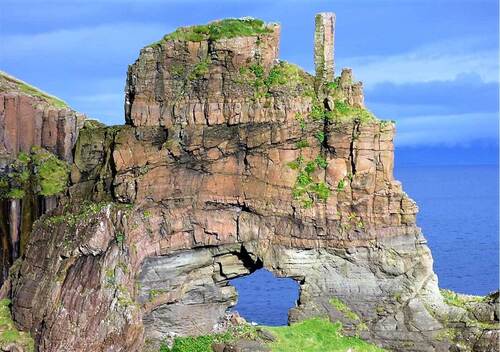
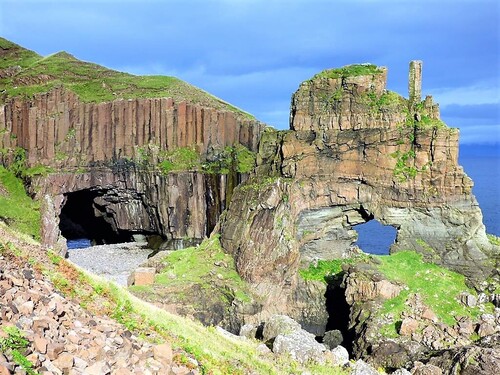
Carsaig Bay is one of the most scenically beautiful locations on the south coast of Mull and a haven for geologists, walkers and wildlife enthusiasts. The hamlet of Carsaig lies enclosed in a natural amphitheatre of towering basalt cliffs, producing some of the highest and most spectacular coastal scenery on the island.
The views from the old pier and during a walk to the world-renowned Carsaig Arches are breathtaking on a clear day, when the Paps of Jura dominate the southern horizon alongside the islands of Colonsay and Islay.
Cast an eye across the Firth of Lorn to the south-east, where the line of the Garvellach Islands (‘Isles of the Sea’) may be traced. The most southerly aligned of these four enchanting isles, Eileach an Naoimh (‘Isle of the Saints’), shelters the bee hive cells of early Celtic missionaries and is the reputed resting place of St.Columba’s mother, Eithne.
Structure – Built upon foundations that stretch back over unimaginable periods of time, the stunning landscapes present at Carsaig Arches owe their origins to the complex geology of an island that continues to attract visitors from all over the world.
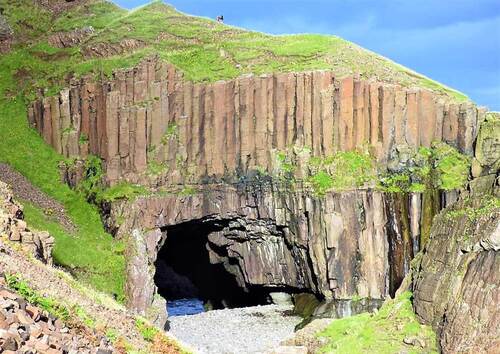
The highly dramatic columnar-jointed rock faces of the imposing cliffs at Carsaig are a comparatively recent example of Mull’s geological history, being formed during a prolonged period of volcanic activity around 60 million years ago.
Successive flows of lava, over at least a 5 million year period, were extruded from fissures on to Mull’s land surface, covering an extensive area of basement rocks. Where the lava has cooled and contracted, pentagonal and hexagonal-sided columns formed, such as can be seen in the cliff scenery at Carsaig and elsewhere in south-west Mull.
Plate Movements – The Isle of Mull hasn’t always had a cool, maritime climate and has been subject to the phenomenon of continental drift over hundreds of millions of years. This has resulted in Mull travelling northwards from a hot, dry desert latitude, through warm, tropical regions, close to the Equator, to its present location in the North Atlantic. Fine grained sands and muds, deposited in shallow seas during such times, are exposed as sedimentary rocks on the shore at Carsaig Bay and contain the fossilised remains of small marine animals.
Visiting the Arches – Muddy and rocky paths lead the walker west along the bay towards the Nun’s Cave and the famous Carsaig Arches, where a variety of wildlife may be encountered. The cliffs are home to Golden Eagle, Buzzard, Kestrel and Raven, as well as the area’s population of feral goats, a relic of a time past when these animals would have been among the first to be domesticated by man on the island. Due to the remoteness of the area and the lack of disturbance, Otters are frequently seen and inquisitive Common Seals provide amusing entertainment for the visitor.
Images courtesy of Seaview Guest House in Fionnphort

Leave a Reply